1/07/2013

Say Hi!

Merhaba;
Biraz da şaşırarak yazıyorum bunu çünkü az önce girişlerden kontrol ettiğim kadarıyla Hong Kong, Güney Kıbrıs Rum kesimi, Birleşik Krallık ya da Amerika gibi gayet benden bağımsız topraklardan günlük izleyicilerim olduğunu farkettim... Blog gizlilik ayarlarımdan ötürü sürekli takip edilemiyor, yorum yapılamıyor biliyorum.. Kişisel nedenlerden ötürü.. Paylaştığım her neyse google'dan aratarak ya da sadece hatırlayabiliyorsanız :) blog ismiyle görüntüleyebiliyorsunuz..Listelerde gözükmediğim için üzgünüm! Ortada çok kayda değer bir profil de yok,..
Ama şekil çok da önemli değil sanırım.. 
teşekkürler

__________________________

Servus;


Writing this post with a little bit astonishment cause a few ago noticed that I have daily followers from the lands which are overseas and free from me such as Hong Kong, Southern Cyprus, U.K and U.S... My blog cannot be followed constantly and is not open to comments due to my privacy settings and furtherly my personal reasons.. Whatever I share you google it or view directly with my blog name if you remember :) Sorry for not being listed at the updating blog lists. Besides; even there is no remarkable profile in view,..
Image is nothing
thanks

____________________________

Salut;

J'écris un peu surpris, parce que j'ai vérifié les entrées aussi loin que Hong Kong, la République de Chypre, le Royaume-Uni ou aux États-Unis les territoires, les téléspectateurs quotidiens indépendants comme moi, j'ai réalisé que c'était une très ... Mon blog de la vie privée ne peuvent pas être surveillés en permanence, les commentaires ne peuvent pas être faite d'un profil remarquable dans le milieu ne sais pas ..

l'image n'est pas significative
merci


merve

____________________________

Maps

Historians have a longstanding and conflicted relationship with maps. It seems that we can't live with them and can't live without them. On one hand, maps are an indispensable tool and object of fascination. They can serve as a guide or a window for exploration and discovery. On the other hand, they are abstractions that impose boundaries that do not really exist and create a seemingly objective picture that belies tremendous biases and assumptions. For this reason, maps are also a subject of intense criticism for academic historians and geographers. Myth of Continents by Martin W. Lewis and Kären E. Wigen, for example, provides a broad and thorough critique of Western metageography.

In this way, maps can serve as historical sources that tell us much more about the past and present than common geographical information. On this page, you will find maps new and old that may be of interest for Ottoman historians. We have selected these maps on the basis of their being interesting and of high image quality, not for any innate importance or precision.


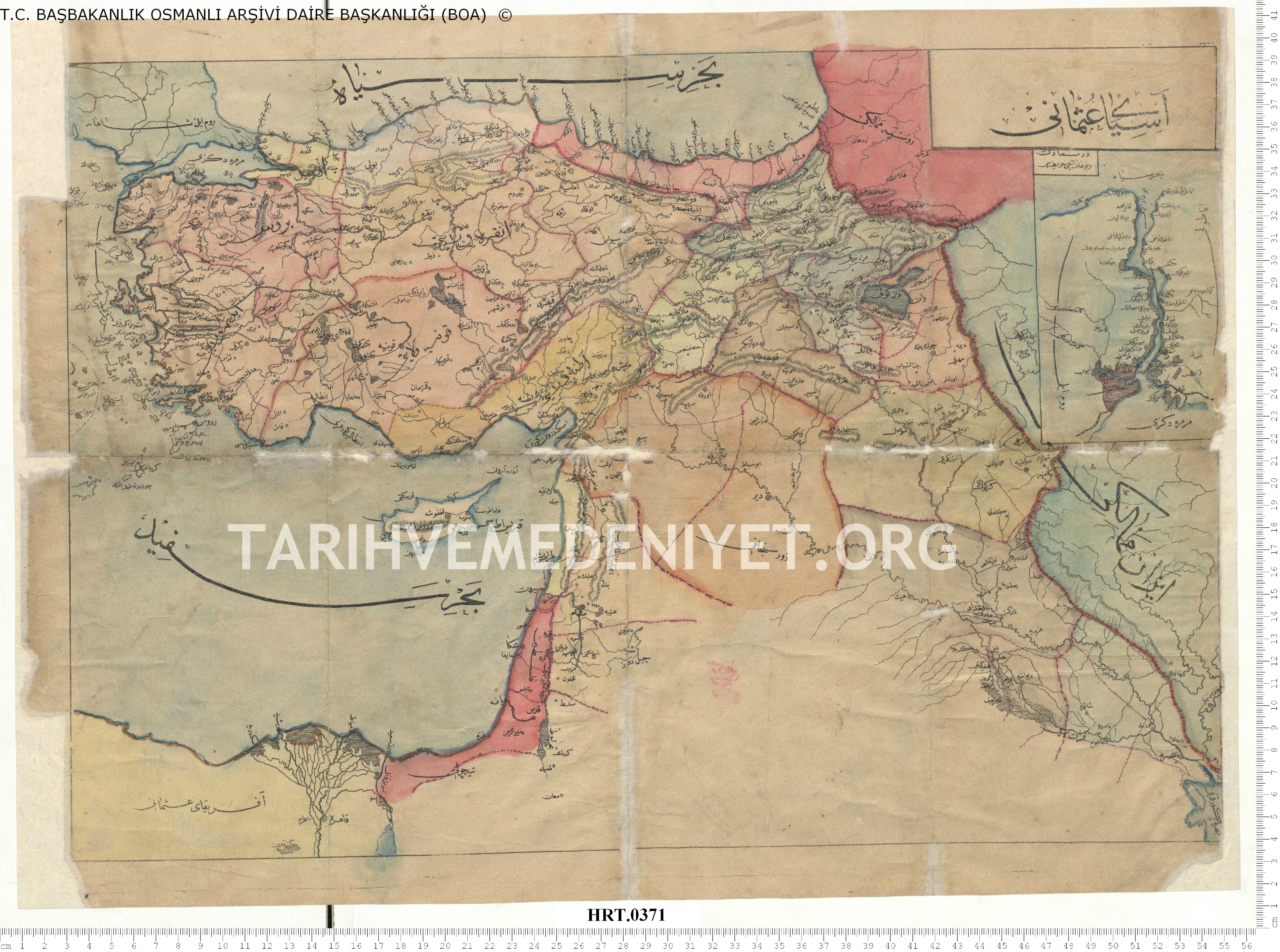
MAP OF OTTOMAN EMPIRE (Ottoman, late-19th Century)
This is a map of the Ottoman Empire's Anatolian and Syrian provinces from the late-nineteenth century. The Başbakanlık Ottoman Archives contain many such maps. This one has been shared on tarihvemedeniyet.org.


PIRI REIS MAP OF MEDITERRANEAN AND NEW WORLD (Ottoman, 16th Century)
Piri Reis was an Ottoman admiral and cartographer. His 1517 work entitled Kitab-ı Bahriye, which contains many detailed maps, included a map of the coast of the New World based on apparently fast-spreading news of the recent European discoveries. 

This copy of his map of the Mediterranean region from the 16th century reflects a startlingly accurate scale and detail for the period.


THE BOSPHORUS AND GOLDEN HORN, CONSTANTINOPLE (Ottoman, 17th Century)
This is a map of Istanbul's waterways and the adjacent settlements as of the 17th century, taken from Katib Çelebi's extensive Cihannüma.


SEUTTER MAP OF OTTOMAN EMPIRE (German, 18th Century)
Georg Matthäus Seutter (1647-1756) was a highly successful German map publisher. This map of the Ottoman Empire from 1730 contains many notable inaccuracies regarding the geography of Anatolia, the Caspian and Dead Seas, and general problems of scale.

There are also quite a few curious labels and placements. For example, if we look at modern-day Armenia, Mt. Ararat is in a completely incorrect location East of Yerevan, and there is a giant island in the middle of Lake Sevan. There are numerous such examples throughout the map. Interesting regions such as Azerbaijan, Kurdistan and "Turcomania" also stand out, and while one would expect Eastern Anatolia and the Caucasus to be somewhat uncharted territory for Europeans, even a relatively central location such as Izmit is quite misplaced and the Mediterranean Sea is simply too small.

Nonetheless it is a fairly detailed and accurate map for its period, and in many was the Seutter map is an interesting reminder of the extent to which the Ottoman Empire was terra incognita even for geographers in Europe at the time.


MÜTEFERRİKA MAP OF PERSIA AND EASTERN ANATOLIA (Ottoman, 18th Century)

Ibrahim Müteferrika was born in Ottoman Transylvania to a Hungarian family in 1674. He converted to Islam and went on to become the first Ottoman to experiment with movable type in the Arabic-Ottoman script during the 1720s.

This map produced by Müteferrika may reflect the influence of his travels as an Ottoman diplomat. It is based in part on a map produced by Homann in 1724 and can be compared with the Seutter map above.


CRIMEA (French, 1867)
This is a map of the Crimea region of modern-day Ukraine. This region was part of the Ottoman Empire, though by the eighteenth century mostly autonomous, and came under Russian influence with the Treaty of Küçük Kaynarca in 1774. Crimea was the main region of dispute during the Crimean War (1853-1856), which pitted the Russians against the Ottomans and their allies in Britain, France, and the Kingdom of Sardinia. It is often referred to as the first "modern war" because of the emergence of certain technologies and institutions associated with modern warfare as well as the global aspect of the conflict.

During and following the Crimean War, many Muslim Tatars left or were forced out of the region and settled in the Ottoman Empire. There would be periods of such migration throughout history, including during World War II, when the Soviet government forcibly deported hundreds of thousands of Tatars to Central Asia in what is remembered as "the Exile (Sürgün).


Ottoman Sources: Mühimme defters with Emrah Safa Gürkan

Mühimme defters

One of the constant concerns for Ottoman historians is the lack of access to and information about source materials. In this podcast, Emrah Safa Gürkan explains the role of one important source, the Mühimme, in writing the history of the early modern Ottoman Empire.


MP3 File

Emrah Safa Gurkan is a PhD candidate studying the history of the early modern Mediterranean at Georgetown University (see academia.edu)

Select Bibliography

Suraiya Faroqhi, "Mühimme Defterleri", Encyclopedia of Islam, 2nd edition, VII, 470-2.

Géza Dávid, The Mühimme Defters as a Source in Ottoman-Habsburg Rivalry in the 16th Century”, Archivum Ottomanicum, 20 (2002): 167-209.

U. Heyd, Ottoman Documents on Palestine (1552-1615): A Study ofthe Fir¬man Accordİng to the Mühimme Defteri (Oxford: Clarendon Press, 1960).


W. S. Peachy, "Register of Copies or Collection of Drafts? The Case of Four Mühimme Defters from the Archives of the Pri¬me Ministry in istanbul", TSAB, X/2 (1986), s. 79-85.

Feridun M. Emecen, "Osmanlı Divanının Ana Defter Serileri: Ahkâm-ı Mîrî, Ahkâm-ı Kuyûd-ı Mühimme ve Ahkâm-ı Şikâyet", Türkiye Araştırmaları Literatür Dergisi, III/5 (2005), pp. 107-139.

Ešref Kovačević, Muhimme Defteri : dokumenti o našim krajevima (Sarajevo, Orijentalni Institut u Sarajevu, 1985).

Mübahat S. Kütükoğlu, "Mühimme Defterlerindeki Muamele Kayıdlan Üzerine", Tarih Boyunca Paleografya üe Diplomatik Semineri: 30 Nisan -2 Mayıs 1986 Bildiriler (İstanbul, 1988), pp. 95-112, 315-331.

Tevfik Temelkuran. "Dîvân-ı Hümâyûn Mühimme Kalemi", Tarih Enstitüsü Dergisi, 6 (1975), pp. 129-175.

Published Mühimme Defters from the 16th century

Halil Sahillioğlu, Topkapı Sarayı Arşivi H. 951-952 Tarihli ve E-12321 Nu¬maralı Mühimme Defteri (İstanbul, 2002).

3 Numaralı Mühimme Defteri (Ankara: Başbakanlık Devlet Arşiv¬leri Genel Müdürlüğü, 1993).

5 Numaralı Mühimme Defteri (Ankara: Başbakanlık Devlet Arşiv¬leri Genel Müdürlüğü, 1994).

6 Numaralı Mühimme Defteri (Ankara: Başbakanlık Devlet Arşiv¬leri Genel Müdürlüğü, 1995).

7 Numaralı Mühimme Defteri (Ankara: Başbakanlık Devlet Arşiv¬leri Genel Müdürlüğü, 1997-1999).

12 Numaralı Mühimme Defteri (Ankara: Başbakanlık Devlet Arşiv¬leri Genel Müdürlüğü, 1999).


www.ottomanhistorypodcast.com

Palestinianism and Zionism during the Late Ottoman Period

Before check the bibliographies or academic publications of the authors I've stated, please listen the MP3 File prepared!

Otherwise, it'll be nonsense to look this post!

merve!

_____________________________________


While it is common knowledge that Zionist settlement in Palestine began during the Ottoman era, conventional historiography has under-emphasized the extent to which the issue of Palestine was a question that initially emerged in an Ottoman political and social context. In this podcast, Dr. Louis Fishman restores this Ottoman context and explores debates between Jewish and Palestinian Ottoman subjects during the Second Constitutional Era.


MP3 File

Louis Fishman is an Assistant Professor of History at CUNY-Brooklyn College (see faculty page)
Chris Gratien is a PhD candidate studying the history of the modern Middle East at Georgetown University (see academia.edu)
Emrah Safa Gürkan is a recent Ph.D. from the department of history at Georgetown University currently teaching at Bahçeşehir University in Istanbul (see academia.edu)

Citation: "Palestinianism and Zionism during the late-Ottoman period," Louis Fishman, Chris Gratien, and Emrah Safa Gürkan, Ottoman History Podcast, No. 84 (December 16, 2012)


Select Bibliography


Louis Fishman. "The Haram al-Sharif Incident: Palestinian Notables versus the Ottoman Administration," Journal of Palestine Studies, 135, Vol. XXXXIV, Number 3, Spring 2005.

Louis Fishman. "The Emergence of a “Jewish” Question in Istanbul 1908-1914: Zionism, Anti-Semitism, and the 1911 Ottoman Parliament Debate on Zionism," in Ben-Bassat, Yuval and Eyal Ginio (eds.), Late Ottoman Palestine: The Period of Young Turk Rule (London: I.B. Tauris, 2011).

Recommend readings from other authors:

Ben-Bassat, Yuval and Eyal Ginio (eds.), Late Ottoman Palestine: The Period of Young Turk Rule(London: I.B. Tauris, 2011).

Campos, Michelle. Ottoman Brothers: Muslims, Christians, and Jews in Early Twentieth-Century Palestine (Stanford: Stanford University Press. 2011)

Jacobson, Avigail. From Empire to Empire: Jerusalem Between Ottoman and British Rule (Space, Place, and Society) (Syracuse: Syracuse University Press. 2011)

Khalidi, Rashid. Palestinian Identity: The Construction of Modern National Consciousness. (New York: Columbia University Press, 1997)

Tamari, Salim. Mountains Against the Sea: Essays on Palestinian Society and Culture (Berkeley, University of California Press. 2009)

Music: Reem Kelani


Turkeys and Vultures: the Ottoman Empire in American satire

This album contains a number of representations involving the Ottoman Empire taken from the American satire magazine Puck, which operated until the First World War (1871-1918). In addition to providing insight into the ways that the Ottoman world and other countires were characterized and charicatured within the American imagination, these images offer critiques about some aspects of the policies of Western states vis a vis the Ottoman Empire. These images have been cropped to illustrate depictions of the Ottoman Empire but links to the entire images can be found in the captions.

"Tough on Turkey" - 1885
Britain and Russia intimidating the Ottoman turkey


"Waiting" - 1912
European powers as vultures waiting to prey on the Ottoman Empire during the Balkan wars


"Uneasy Turks" - 1908
From the Thanksgiving edition of 1908, a play on words in reference to the Young Turk revolution


"John Bull's dilemma" - 1895The certain doom awaiting the Ottoman Empire's Christian communities was a common theme in the Western press, but this cartoon also points to the ambivalent role of Western states in this dynamic at the time of the Armenian massacres in 1895.


For the entire images please visit www.loc.gov.
merve

Beirut!

Street leading to Ras Beirut
Beirut, Lebanon
American Colony, c1900-1920


(LOC - http://www.loc.gov/pictures/item/mpc2004003849/PP/)

J'adore cette partie de Beyrouth ''Ras Beirut''. Foi 2008 quando eu estava em Beirute, capital do Líbano, Era um mes de Julho ''Tamouz'' calendario arabe!

Bulunduğu bölgeye on yıllardır atlanmıyor olsa da gitsek, kebabını yiyip nargilesini içsek, Roma'dan bu yana bu topraklarda egemen olan tüm kültürlerin özetini görsek dediğimiz Beyrut...

1/06/2013

Benim yegane sebebim mi neydi?

çok içti.. sarhoş oldu.. acı içindeydi.. benden dolayi aci çektiğini düşünüyordu.. rakı şişesinin dibini de içti.. sonra rakı şişesini kafamda kırdı. şişenin elinde kalan parçasını göğsüme sapladı, sonra kendi göğsüne..
dördümüz de öldük..


sen bay nihayet! sen ölümüm kalımım
ben artık adam olmam bu derde düşeli

inan belli etmem, seni hiç rahatsız etmem,
son isteğimi de söyleyebilirim şimdi:

bir geceyarısı yazıyorum bu mektubu
yalvarırım onu okuma pazar günleri...


merve